Guide · Updated September 29, 2026 · 8 min read
Québec's Direct Compensation Agreement, explained step by step
Disclosure: this article is published by SoumissionAuto.ca, an independent information site. If you request a quote through our links, we may receive compensation from licensed partners, at no cost to you. Learn more.
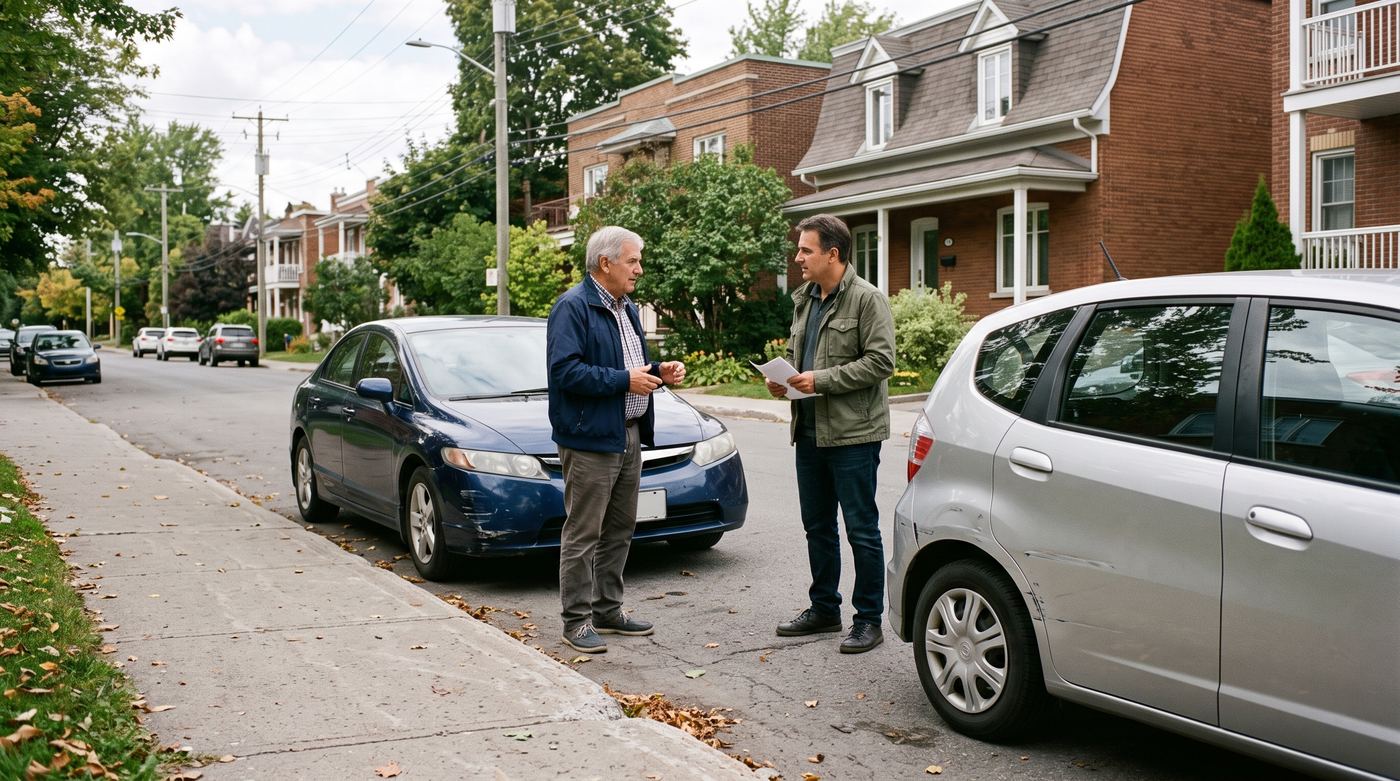
A crumpled bumper at a red light, a scraped fender in a parking lot: in Québec, what happens after a fender-bender is not what you often see in the movies. You claim nothing from the other driver's insurer, and they claim nothing from you either. Each driver calls their own insurer, which compensates them for the damage to their vehicle according to their share of fault.
This mechanism is called the Direct Compensation Agreement (Convention d'indemnisation directe), often shortened to CID. Drafted and updated by the Groupement des assureurs automobiles (GAA), it binds auto insurers and contains liability scales that set each driver's share of fault according to the accident scenario.
A reminder before we start: the Agreement covers property damage. Injuries fall under the SAAQ's public plan, which compensates accident victims whether or not they were at fault.
Each driver is compensated by their own insurer
According to the GAA, each insurer compensates its own insured for property damage, whether or not the insured was at fault in the collision. The text of the Agreement states that the insurer compensates its insured to the extent of the liability of the drivers of the other vehicles, in their place and stead. In other words, your insurer pays you what the other driver would have owed you.
The insurers do not then reimburse one another: according to the GAA, they no longer exercise their right of subrogation against each other, which has shortened settlement times and reduced settlement costs.
This principle has a legal basis. Section 116 of the Automobile Insurance Act, reproduced at the start of the Agreement, provides that when the Agreement applies, the owner exercises their recourse for property damage only against their own insurer. The same section allows an owner who is dissatisfied with the settlement made under the Agreement to exercise that recourse against their insurer under the ordinary rules of law.
The Q.P.F. No. 1, the standard policy approved by the Autorité des marchés financiers (AMF), places this compensation under Chapter A, the civil liability chapter (called Section A in the official English form): even a driver who holds only that chapter is compensated for their car when they are not at fault.
When the Agreement applies
The GAA sums up the conditions this way: the collision happens in Québec, it involves at least two vehicles, the owners of the vehicles are identified, the vehicles belong to different owners and the driver did not hit their own vehicle. The Agreement defines a collision broadly: any contact, including all types of impact, between vehicles or detached parts of vehicles, or between a vehicle and a load falling from another vehicle.
In practice, here is who pays for the damage to your vehicle, depending on the situation:
- A collision in Québec between two vehicles with different owners, all identified: the Agreement applies, and your insurer compensates you according to your share of fault.
- A hit and run, when the other driver leaves the scene without identifying themselves: the Agreement does not apply. The GAA specifies that you will be compensated if you hold the “all perils” or “collision or upset” protection, after your deductible is subtracted.
- A collision in the United States: the Agreement does not apply; the ordinary rules of liability and your coverages come into play.
- A collision with a tree or a pole: the Agreement does not apply; your Chapter B compensates you according to the protections you bought.
These last three examples are the ones the GAA gives to illustrate the excluded cases.
Compare before you decide
One request, up to three quotes from licensed Québec partners. Free and no obligation.
Compare my auto insurance quotesThe scale, or how fault is set
The Agreement uses liability scales to illustrate the vast majority of possible accident scenarios and determines each driver's share of fault. According to the GAA, these scales are based on the Highway Safety Code and on case law, and insurers must use them to set their insured's share of fault. Cases that the scales do not cover are handled under the ordinary rules of law.
Two rules of the scale often surprise people. First, unless it provides otherwise, the scale takes into account neither the point of impact, nor speed, nor weather conditions, nor visibility, nor the state of the road. A rear-end collision on an icy road is still a rear-end collision. Second, the scale declares any admission of liability, and any prior agreement on the subject, null and void. Saying “it's my fault” in the heat of the moment therefore does not set your share.
Here are a few cases taken from the scale published by the GAA:
| Scenario | What the scale provides |
|---|---|
| A vehicle hits the rear of the vehicle ahead of it in the same lane | 100% for the vehicle that hits, 0% for the other |
| A vehicle changes lanes and hits a vehicle in the other lane | 100% for the vehicle changing lanes |
| Two vehicles travelling in different lanes sideswipe each other, with no lane change | 50% each |
| A vehicle reverses or makes a U-turn | 100% for the vehicle reversing, shared equally if several are reversing |
| A vehicle leaves a parking space and causes the accident | 100% for the vehicle leaving the parking space |
The GAA points out that the official version of the Agreement prevails and that it is up to your insurer to determine your share of fault after its investigation. Your file in the Fichier central des sinistres automobiles, Québec's central auto claims file, will then show the percentage applied, which is 0%, 50% or 100%, as explained in our guide to the central claims file and your driving record.
When your deductible applies
The answer depends on your share of fault and on the protections you chose under Chapter B (Section B in the English form), which covers damage to your own vehicle: B1 (all perils), B2 (collision or upset), B3 (accidents without collision or upset) and B4 (specified perils). For a collision, B1 and B2 are the ones that count; the form now in force describes Protection 2 as the “collision and upset” perils.
According to the GAA, if you are not at fault, you will be compensated even if your policy does not cover collision, with no deductible to pay. If you are at fault, you will be compensated only if your policy covers collision, and you will pay your deductible. The Agreement also settles the shared case: the collision deductible payable equals the proportion of the damage for which you are responsible, multiplied by the deductible.
| Your share | Paid under the Agreement, no deductible | Paid by your Chapter B (B1 or B2) | Collision deductible |
|---|---|---|---|
| 0% | All of your damage | Nothing to claim | None |
| 50% | Half of your damage | The other half, if you hold the protection | Half of your deductible |
| 100% | Nothing | All of it, if you hold the protection | Full |
Within certain limits and with supporting documents, the Agreement also covers the loss resulting from the vehicle being immobilized and property being carried: keep your receipts. Finally, if you hold only Chapter A, the share for which you are responsible remains at your expense.
The joint report, the basic tool at the scene
Offered by the GAA, the joint report (constat amiable) is used after a collision without injuries. It can be filled out online, on a phone or tablet, or on paper. According to the GAA, it lets the parties identify themselves and quickly report the accident to their respective insurers, without having to call the police for a simple fender-bender.
The steps described by the GAA:
- One driver detaches the lower part of the report and gives it to the other.
- Each driver fills out the accident information section of their own form.
- Each driver hands their form to the other, who fills out the section on the other vehicle involved.
- Each driver takes back their own form, notifies their insurer or broker and sends them the report without delay.
The GAA is clear: filling out a joint report is not an admission of liability; it is simply a record of the accident. No maximum deadline applies, but the GAA recommends filling it out as soon as possible and keeping a copy for six years. If the other driver refuses to cooperate, nothing obliges them to fill out the report; note their licence plate, take photos, call the police if needed and contact your insurer quickly.
What to note before leaving the scene
The scale reasons from manoeuvres: what each vehicle was doing at the moment of impact matters more than the extent of the damage. Before you leave:
- If anyone is injured, call the paramedics and the police immediately.
- Without a joint report, exchange at least your name, address, phone number, driver's licence number, registration certificate number and insurer's contact information, as the GAA recommends.
- Note the exact location, the time, the direction of each vehicle and the manoeuvre under way: changing lanes, reversing, leaving a parking space, turning.
- Photograph the position of the vehicles, the damage on both sides, the signs and the road markings, and collect the witnesses' contact information.
- Settle nothing privately: the Q.P.F. No. 1 provides that, except at their own expense, the insured must neither comment on their liability nor settle a claim, and that an agreement made without the insurer's consent does not bind the insurer.
Then report the accident to your insurer, even if you do not plan to claim anything. The GAA recommends it so that your version of the facts is recorded in your file, and points out that reporting a loss does not commit you to making a claim.
If you dispute your share of fault
Ask your insurer which case of the scale it applied and which facts it relied on, then provide anything that could change the analysis: joint report, photos, witness statements. According to the GAA, only your insurer can change the percentage of fault recorded in your file.
If the disagreement persists, section 116 of the Automobile Insurance Act allows you to exercise your recourse against your insurer under the ordinary rules of law. The insurer's complaint process, followed by the transfer of your file to the AMF, is described in our guide to the steps of a claim. The GAA's Centre d'information sur les assurances (Info-Assurance) can also answer your questions free of charge.
What the Agreement changes when you compare
Since your own insurer compensates you, even when the other driver is at fault, your contract matters more than people think. A Chapter B that includes B1 or B2, and the amount of your deductible, determine what you will receive on the days you are at fault: compare them from one quote to the next, in addition to the premium.
We are neither an insurer nor a broker: we explain how auto insurance works in Québec, and our licensed partner presents quotes to you.
Compare before you decide
One request, up to three quotes from licensed Québec partners. Free and no obligation.
Compare my auto insurance quotesSources
- Groupement des assureurs automobiles (GAA), gaa.qc.ca: Direct Compensation Agreement (official text and liability scale, which reproduces section 116 of the Automobile Insurance Act), joint report, settling an auto claim, Centre d'information sur les assurances.
- Autorité des marchés financiers (AMF), lautorite.qc.ca: Québec Automobile Insurance Policy Q.P.F. No. 1, Owner's Form.
- Éducaloi, educaloi.qc.ca: “L'assurance automobile : ce que vous devez savoir” (page in French).
Pages consulted on September 29, 2026.