Guide · Updated September 29, 2026 · 8 min read
Winter tires, telematics and vehicle use, what matters for your insurance
Disclosure: this article is published by SoumissionAuto.ca, an independent information site. If you request a quote through our links, we may receive compensation from licensed partners, at no cost to you. Learn more.
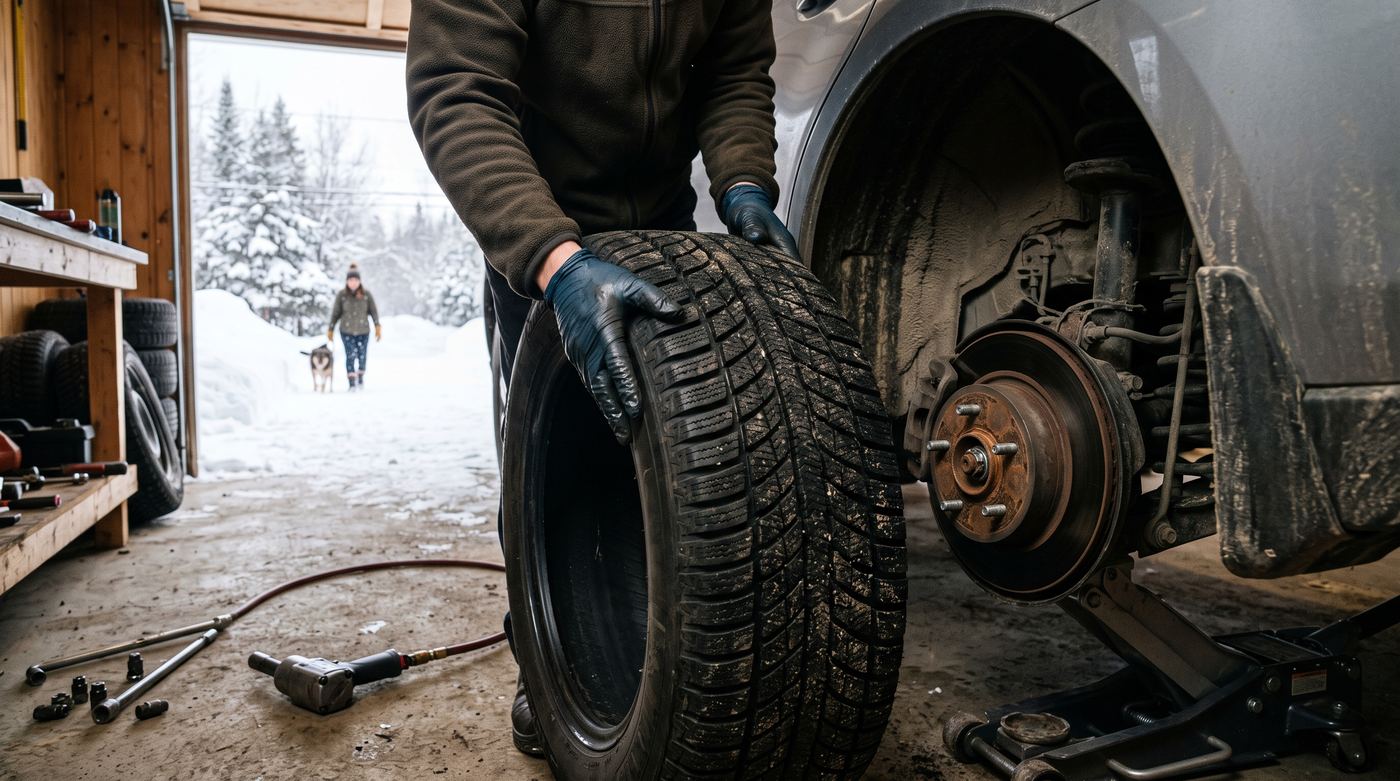
Three topics come up often when people talk about auto insurance in Québec: winter tires, how the vehicle is really used and the telematics programs that record your driving. The first falls under the Highway Safety Code, the other two under your contract. Here is what you need to know, especially if you use your car for work, deliveries or carrying passengers.
Winter tires, an obligation under the Highway Safety Code
According to the SAAQ, from December 1 to March 15 inclusive, all motorized road vehicles registered in Québec, other than heavy vehicles, tool vehicles or farm machinery, must be fitted with winter tires. The obligation also covers passenger vehicles offered for rent in Québec, mopeds and motorcycles, and the SAAQ refers to four compliant winter tires in good condition.
To be recognized as a winter tire under the Highway Safety Code, a tire must bear the official pictogram showing a mountain and a snowflake, or be studded. According to the SAAQ, the fine ranges from $200 to $300, plus costs. Studded tires, for their part, are allowed from October 15 to May 1 inclusive, in particular on passenger vehicles.
The SAAQ provides for a few exceptions, notably the first 7 days after buying a vehicle from a dealer, the 7 days before the end of a lease of 12 months or more, the spare wheel, and a vehicle for which an exemption certificate has been issued, to be requested in SAAQclic or at a service point.
Since winter often arrives before the deadline, the SAAQ recommends, depending on your region, having your tires installed before December 1, and suggests a tread depth of at least 4.8 mm at the time of installation.
And what about your insurance
Info-Assurance, the website of the Centre d'information sur les assurances, answers the question many people ask: you will be compensated after a fender-bender in the middle of winter even if your winter tires are not installed, provided you have the protections required under your contract. But the claim will be recorded in your file, and you risk the fine. The same site specifies that a theft that happens while the engine is running to warm up the car is still compensated if you hold theft coverage, even though it is better not to make things easy for thieves.
Winter tires do not exempt anyone from adapting their driving either. Info-Assurance points out that bad road conditions do not relieve you of your responsibility. The liability scales of the Direct Compensation Agreement, for that matter, do not take weather or road conditions into account, unless they provide otherwise: a rear-end collision on ice remains the responsibility of the vehicle that hits, as our guide to the Direct Compensation Agreement explains.
On the contract side, Chapter B of the Q.P.F. No. 1 (Section B in the official English form) excludes damage to the tires themselves, unless it coincides with other covered damage or results from a covered fire, theft or malicious act. And if you store a vehicle for the winter, two endorsements approved by the AMF, Q.E.F. No. 16 and No. 17, allow certain coverages to be suspended during storage, then put back in force.
Compare before you decide
One request, up to three quotes from licensed Québec partners. Free and no obligation.
Compare my auto insurance quotesThe declared use of the vehicle
The Q.P.F. No. 1 requires you to declare, at subscription, during the contract and at renewal, any information that may influence the risk, including any change in the use of the vehicle and the fact that other people drive it. The town and province of your address are deemed to be the places where the vehicle is mainly used, stored and parked; if that is not the case, you must declare it.
The AMF gives concrete examples of situations to report: your job now requires you to use your vehicle for business, for example to visit clients; a new job makes your commute longer; you often lend your vehicle; you are paid to carry passengers; you move; you have had an accident; or you make a major improvement that increases the vehicle's value. In that last case, keep your invoices: the AMF warns that you may have to prove those improvements.
| Use | Example | What to declare |
|---|---|---|
| Pleasure | Errands, leisure, visits | The estimated annual distance |
| Commuting to work or school | Going to the office or to class | The commuting distance, a change of job |
| Business | Visiting clients, going to job sites | Any new use for work |
| Delivery of goods | Delivering for a restaurant or a store | The activity, before you start |
| Paid transportation of passengers | Driving through a mobile app | The activity, before you start |
The exact labels vary from one insurer to another: what matters is that your description matches reality.
If the risk increases, the AMF indicates that the insurer can raise the premium, or even, in some cases, end the contract. The Q.P.F. No. 1 provides that it can propose a new premium to you in writing, to be accepted and paid within 30 days, failing which the contract ends. Conversely, a false declaration or a concealment likely to substantially influence a reasonable insurer allows the insurer to ask for the chapter concerned to be annulled; in other cases, the indemnity can be reduced in proportion to the premium paid compared with the premium that would have been charged.
Annual mileage
The AMF lists the distance driven among the criteria that influence the premium, along with use of the vehicle for work. Estimate your mileage honestly, based on the odometer, and report a significant change: a new job farther away, working from home, retirement. Such a change can alter the premium, in either direction, according to each insurer's rules.
Telematics and usage-based insurance
Some insurers offer telematics, a technology that records information about the way you drive: a device installed in the vehicle or an app on your phone sends data such as top speeds or sudden stops and starts. According to the AMF, the insurer then uses this information to calculate your premium: you could get a discount or, on the contrary, see the price of your insurance go up. Some insurers review the premium every month.
Joining is a choice, and the AMF encourages you to understand the program well before accepting it. It suggests finding out about the following points:
| Question to ask before joining | Why |
|---|---|
| What data will the insurer receive? | Mileage, hard braking, trips: know what is measured |
| Who will be able to consult the data? | The confidentiality of your travels |
| Over what period is the premium calculated? | Every month, every six months or otherwise |
| Which discounts and which increases are possible? | The premium can move in both directions |
| How is your personal information protected? | The security of the data |
| How do you leave the program? | Keep the option of withdrawing |
The AMF adds that your insurer must commit not to use your data to refuse you a claim after an accident or to decide to stop insuring you. Two warnings complete the picture: if someone else drives your vehicle, the way they drive can influence your price, and no technology is entirely safe from hackers.
Car sharing, carpooling and paid driving
The Q.P.F. No. 1 excludes, under Chapter A as under Chapter B, losses that occur while the insured vehicle is rented to another person or used as a taxi or as any other vehicle provided with a driver. The insurer can agree to cover these situations by specifying them in the Declarations or through an endorsement. Renting your car to private individuals through a car-sharing platform, or carrying passengers for pay, therefore falls outside the basic contract: ask the platform which insurance applies and when, and ask your insurer whether an endorsement is needed.
For paid transportation of passengers through an app, the AMF explains that the company running the app must hold auto insurance. You must still inform your insurer of your intention to offer your services. For your personal needs, your own insurance covers you; as soon as you open the app to make yourself available, the company's insurance applies, until you close it. You keep the protections chosen for your personal insurance, and your deductibles stay the same; if your personal contract has no protection for damage to your vehicle, you will not have any during that activity either. Endorsement Q.E.F. No. 48 addresses this paid transportation.
For deliveries, the AMF distinguishes two cases. A salaried delivery driver can be covered by the employer's insurance while available for a delivery, which is what endorsement Q.E.F. No. 48a provides for. A self-employed driver, or an employee whose employer holds no insurance, is not covered for that activity by their personal contract: they must inform their insurer and, if it cannot cover the activity, find an insurer that will. After a loss, always notify your own insurer, then the company or employer concerned.
If you simply share the costs of a trip with colleagues, ask your insurer how it classifies that situation: it is not the same thing as paid transportation.
What to declare, and when
- A new job, a longer commute or business use: notify the insurer without waiting for renewal.
- Starting deliveries or paid passenger transportation: notify the insurer before you start.
- Frequently lending the vehicle to another driver: notify the insurer.
- Storing the vehicle for the winter: ask about the storage endorsements.
- Joining a telematics program: read the conditions and ask the questions suggested by the AMF.
We are neither an insurer nor a broker: we explain these rules, and our licensed partner presents quotes to you based on the use you declare.
Compare before you decide
One request, up to three quotes from licensed Québec partners. Free and no obligation.
Compare my auto insurance quotesSources
- Société de l'assurance automobile du Québec (SAAQ), saaq.gouv.qc.ca: winter preparation and the winter tire obligation.
- Info-Assurance, Centre d'information sur les assurances, infoassurance.ca: the article on winter accidents and auto insurance.
- Autorité des marchés financiers (AMF), lautorite.qc.ca: the pages on telematics, on offering your services as a driver or delivery person, on avoiding problems with auto insurance and on how premiums are determined, the Q.P.F. No. 1 and endorsements Q.E.F. No. 16, 17, 48 and 48a.
- Groupement des assureurs automobiles (GAA), gaa.qc.ca: liability scale of the Direct Compensation Agreement.
Pages consulted on September 29, 2026.