Guide · Updated September 29, 2026 · 8 min read
Auto Insurance for Young Drivers in Québec
Disclosure: this article is published by SoumissionAuto.ca, an independent information site. If you request a quote through our links, we may receive compensation from licensed partners, at no cost to you. Learn more.
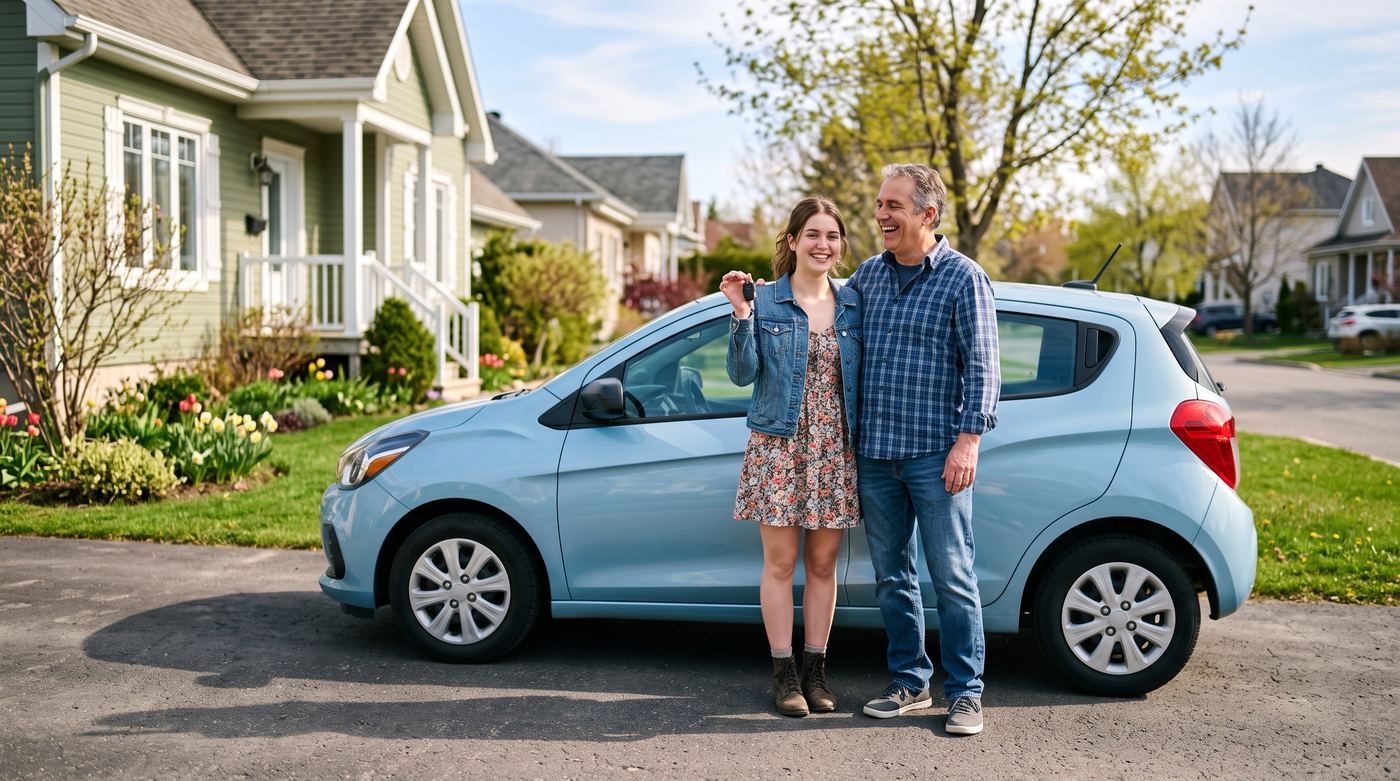
Getting a licence is a milestone; getting insured is another. For a new driver, the premium reflects one thing first: the lack of a history. The insurer does not yet have years of driving to rely on, and the Autorité des marchés financiers (AMF) names age and how long you have held a licence among the elements that affect the premium.
This guide is for young drivers as well as for parents who share their vehicle: the licence stages, how to declare a new driver, the record that builds over time, driving courses and telematics.
The licence stages at the SAAQ
According to the Société de l'assurance automobile du Québec (SAAQ), before holding a class 5 (car) driver's licence, you must obtain a learner's licence and hold it for 12 months, successfully complete a driving course, pass the SAAQ's knowledge test and road test, and then hold a probationary licence for 24 months. The course is taken at a driving school recognized by the SAAQ, which also offers a logbook for supervised driving and, for minors, a parental authority consent form.
| Stage (SAAQ) | What it allows | On the insurance side |
|---|---|---|
| Learner's licence | Supervised driving during the learning period, which lasts at least 12 months | Notify the insurer of the vehicle being used and respect the licence conditions |
| Probationary licence | Driving alone for 24 months, under stricter rules | Declare the new driver according to their real use of the vehicle |
| Driver's licence | Driving without the restrictions of the probationary period | The record keeps building, year after year |
During the learning period, the young person usually drives the parents' vehicle: it is their contract that applies, and it is up to them to notify the insurer. How each insurer takes a learner into account varies; ask before the first outings.
Rules specific to new drivers
According to the SAAQ, holders of a learner's licence or a probationary licence are subject to a 4-demerit-point regime and to the zero-alcohol rule. Points accumulate when a person is convicted of certain offences; when the threshold of their regime is reached or exceeded, the licence is revoked. The SAAQ specifies that points can even be entered on the record of someone who was not driving, for example a passenger not wearing a seat belt. The threshold then rises with age.
| Situation (SAAQ) | Demerit point regime |
|---|---|
| Learner's licence or probationary licence | 4 points |
| Driver's licence, under age 23 | 8 points |
| Driver's licence, age 23 and 24 | 12 points |
| Driver's licence, age 25 or older | 15 points |
Points remain on the record for two years from the date of conviction, and the SAAQ states that they increase the insurance contribution paid with the licence. Under reciprocity agreements, points received in Ontario, Maine and New York State can also be entered on your record. One last detail matters for insurance: a learner who drives unaccompanied is not respecting the conditions of the licence, and, according to Info-Assurance, compensation may be compromised if the person at the wheel was not entitled to drive.
The licence is the SAAQ's business; insurance, on the other hand, is something you compare.
Compare before you decide
One request, up to three quotes from licensed Québec partners. Free and no obligation.
Compare my auto insurance quotesDeclaring a young driver, principal or occasional
Insurance follows the vehicle: under Chapter A of the Q.P.F. No. 1, the standard policy (called Section A in the English version of the form), anyone who drives an insured vehicle is an insured person. But the insurer needs to know who drives. The form requires you to report whether persons other than the named insured drive the vehicle, as well as any change in the drivers' circumstances, and the AMF lists frequently lending the vehicle to another driver among the situations to report.
Two statuses come up in quotes:
- Principal driver: the person who drives the vehicle most of the time.
- Occasional driver: a person who drives it from time to time, less than the principal driver.
The premium takes into account the profile of each declared driver, but the status must match reality. Declaring a parent as the principal driver of a car the young person uses almost every day is a misrepresentation. The Civil Code of Québec, echoed in the Q.P.F. No. 1, requires you to declare the known circumstances likely to materially influence the insurer in analyzing the risk, deciding to accept it or setting the premium. Under the form, a misrepresentation can lead to the cancellation of the chapter concerned or to a reduced indemnity.
On the parents' contract or on their own
| Added to the parents' contract | Their own contract | |
|---|---|---|
| When | The vehicle belongs to the parents | The young person owns the vehicle |
| Status | Principal or occasional, according to real use | Named insured and, generally, principal driver |
| Legal obligation | The owner's, meaning the parents' | As owner, the young person must hold the civil liability insurance required by law |
| Loss caused by the young driver | Recorded in their name in the central claims file, and may also weigh on the parents' contract | Recorded in their name in the central claims file |
The choice depends first on ownership. If the young person buys their car, they become its owner, and the insurance obligation under the Automobile Insurance Act falls to them. If the registration is in a parent's name while the young person is the real owner, the Declarations of the Q.P.F. No. 1 require the actual owner and the registered owner to be declared.
In the Fichier central des sinistres automobiles, the central auto claims file, according to the Groupement des assureurs automobiles (GAA), a loss is attributed to a single person: the custodian of the vehicle (gardien du véhicule), meaning the person at the wheel. An accident caused by the young person driving the family car is therefore entered on their record. If you one day move from being a declared driver on your parents' contract to your own contract, ask the insurer how those years will be taken into account.
Borrowing or lending a car
A young driver may borrow a friend's car, or lend their own. According to Info-Assurance, you can lend your car occasionally, provided the person has your permission and a valid driver's licence. If the friend driving your car is not responsible for an accident, you are compensated even if you only have civil liability coverage; if the friend is responsible, you are only compensated if you have coverage for damage to the vehicle. Your friend's insurer can also pay for the damage to your vehicle if your friend is responsible and has added Q.E.F. No. 27 to their contract. In every case, Info-Assurance notes, the accident is entered on the record of the person who was driving. If lending becomes frequent, the AMF recommends informing your insurer.
A record that builds over the years
At the start, the insurer has little information. Each year adds to it:
- At the SAAQ, the driving record shows, among other things, offences, demerit points and driving experience; you can obtain it free of charge.
- In the Fichier central des sinistres automobiles, according to the GAA, losses from the past six years are recorded, whether or not a claim was made.
- At the insurer, the AMF indicates that a premium can be lower if you have held a licence for several years, with no offences or accidents.
A slip early on can weigh for years, since the claims file covers six years. Conversely, a clean record that grows longer strengthens your profile from one renewal to the next. There is no shortcut: time and caution do most of the work.
Driving courses
The driving course is part of the SAAQ's mandatory path to a class 5 licence. Beyond it, advanced training exists, for example in winter driving or defensive driving, and the SAAQ publishes its own advice on driving in winter. Some insurers may take recognized training into account: ask when you get a quote and keep the certificate.
Telematics programs
According to the AMF, some insurers offer telematics: a chip installed in the vehicle or an app on your phone records information about how you drive, such as top speeds or sudden stops and starts. Depending on the results, you could get a discount or, on the contrary, see the price of your insurance go up.
For a careful young driver, it is a way to show good habits, but it is also a collection of data. Before joining, the AMF suggests finding out, in particular, about:
- the type of information the insurer will receive and who will be able to consult it;
- the period over which the premium is calculated;
- the possible discounts, but also the increases the insurer could impose;
- how your personal information is protected and how to end the program.
The AMF states that the insurer must commit not to use this data to deny a claim or to stop insuring you. And if someone else uses the vehicle, the way that person drives could affect the price: a point to discuss as a family.
Guideposts for parents and young drivers
- Notify the insurer as soon as someone in the household starts driving the vehicle, including with a learner's licence.
- Declare each driver's real status, principal or occasional.
- Ask for a quote before buying a first vehicle: according to the AMF, the make, model, year, value, engine power and cost of parts affect the premium, and, for certain models frequently targeted by thieves, the insurer may require an anti-theft or tracking device.
- If the young person leaves to study elsewhere with the vehicle, report it: where the vehicle is kept is part of the contract.
- Compare quotes that cover the same protections and the same deductibles.
See also our guides to the factors that affect your premium and to the deductible.
We explain; the quotes come from licensed partners.
Compare before you decide
One request, up to three quotes from licensed Québec partners. Free and no obligation.
Compare my auto insurance quotesSources
- Société de l'assurance automobile du Québec (SAAQ), saaq.gouv.qc.ca: obtaining a car licence (class 5), demerit points, obtaining a driving record, winter driving.
- Autorité des marchés financiers (AMF), lautorite.qc.ca: how the price of auto insurance is determined, telematics, how to limit problems with auto insurance, Q.P.F. No. 1.
- Groupement des assureurs automobiles (GAA), gaa.qc.ca: Fichier central des sinistres automobiles.
- Info-Assurance (IBC and GAA), infoassurance.ca: lending your car and insurance.
- Automobile Insurance Act (Loi sur l'assurance automobile, CQLR, chapter A-25) and Civil Code of Québec, LégisQuébec, legisquebec.gouv.qc.ca.